Photochromic & sun · Product
What's Better About Essilor Transitions Gen S
A new photochromic generation is usually just marketing. Gen S is the exception: the change is measurable, and measurable at exactly the point people find most annoying — how long a lens stays dark after you walk indoors.
Transitions Gen S (launched 2024) clears back to transparent faster than Gen 8, adds five style colors alongside the three original shades, blocks 100% of UVA and UVB in both states, and filters part of the blue-violet light. It suits people who move often between indoors and strong sun. Try comparing both generations side by side at Manh Long Optical, 147A Le Duan, Cua Nam.
In this article
What is Transitions Gen S?
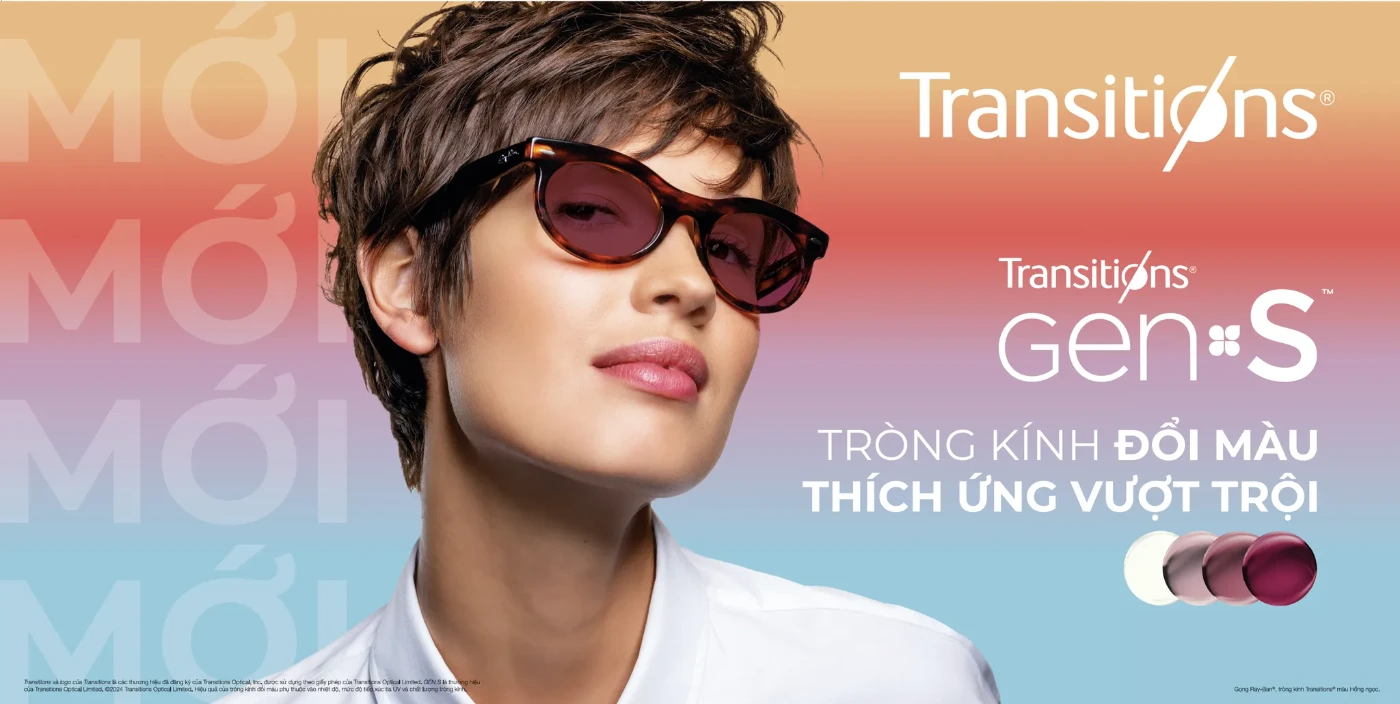
Gen S is Essilor's current photochromic generation, launched in 2024 and built around three ideas: Gen Speed for reaction time, Gen Style for the color range, and Gen Smart for light filtering and UV protection built into the lens.
The mechanism is a redesigned light-sensitive molecular matrix, built into the lens material itself. It reacts to UV almost instantly compared with earlier generations, which is what removes that waiting feeling when you step from indoors into strong sun.
Color-change speed — both directions
In sunlight, Gen S reaches sunglasses-level darkness in about 25 seconds. That part was never really the problem — every photochromic lens darkens fast enough.
The improvement is in the return trip: clearing back to transparent up to twice as fast as the previous generation (Gen 8), in Transitions' own tests on gray lenses. That's the difference between sitting in a meeting with a visibly dark lens or not, and it's the single strongest reason to choose Gen S over a cheaper photochromic lens.
Eight color choices instead of three
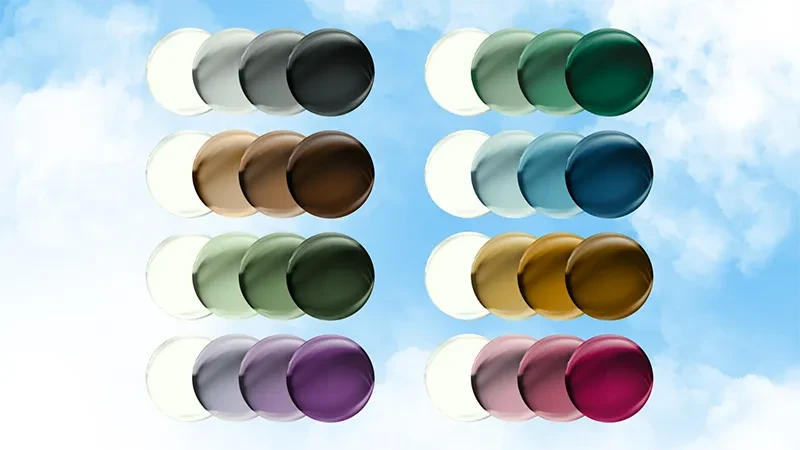
Alongside gray, brown and graphite green, Gen S adds style colors: ruby, amber, sapphire, amethyst and emerald. Gray keeps things neutral, brown boosts contrast, and the style colors are a deliberate aesthetic choice, not an optical one.
Two practical notes: the clear state is closer to true clear than earlier generations — this matters indoors and in photos — and the darkened state has more even color across the whole lens. Try the color against your own frame before ordering.
Blue-violet and UV filtering
Gen S blocks 100% of UVA and UVB in both the clear and darkened states, and this is the part that genuinely protects the eyes — cumulative UV exposure is linked to cataracts and macular degeneration.
It also filters part of the high-energy blue-violet band from screens. Worth being accurate about this part too: clinical evidence that blue-light filtering reduces eye strain is still weak. Treat it as a bonus alongside the UV protection, not the main reason to buy.
Contrast and glare control
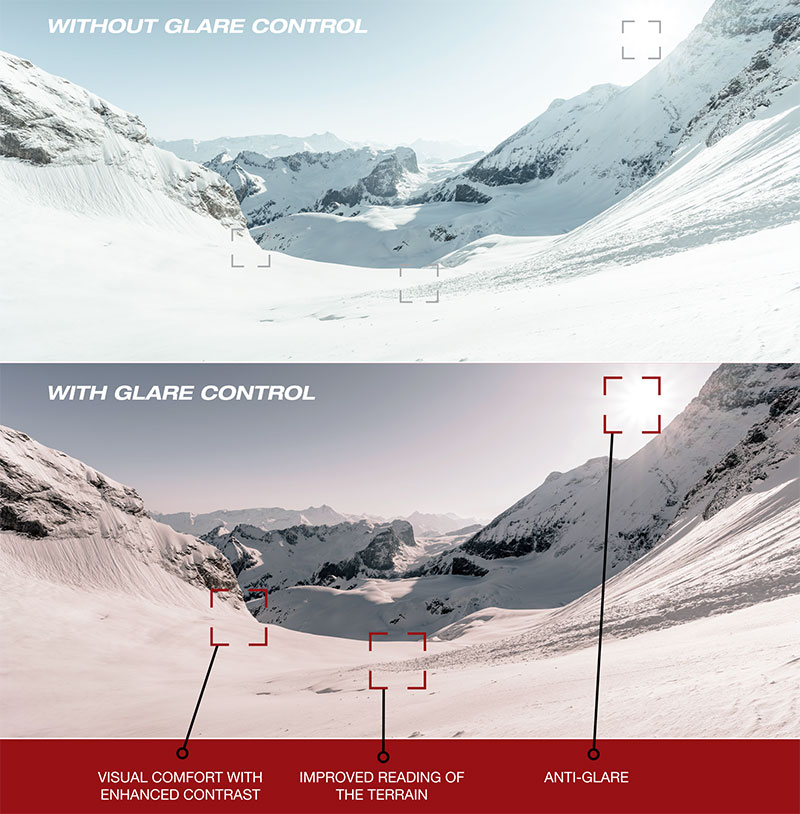
By regulating how much light reaches the eye, a photochromic lens reduces glare and boosts perceived contrast outdoors. Colors look richer and edges look cleaner than looking through a clear lens in the same light.
The real-world benefit is less squinting through a day of constantly changing light — exactly what causes eye strain and headaches by evening. Useful if you drive, take photos, or work outdoors.
Frames, thickness and coatings
Gen S can be fitted into almost any frame type — slim metal, acetate, rimless if the edge is thick enough — and is available across multiple index levels, so a strong prescription doesn't force you into a thick lens.
Pair it with a Crizal coating — Sapphire HR or Rock — for scratch, water, dust and fingerprint resistance. On a photochromic lens this matters more than usual: a scratch shows up more clearly against a tinted background than on a clear lens.
Why buy Essilor Gen S at Manh Long Optical
Single-vision Gen S lenses take two to three days, and Gen S progressives four to five days. For prices by index, see Transitions Gen S prices; for Gen S in a progressive lens, see photochromic progressive lenses.
A lens this technical is only as good as the measurement behind it. We're an official Essilor partner with modern refraction equipment, and we take the pupillary center and fitting height on the actual frame you've chosen — not an average number.
Every pair of Gen S lenses that leaves the shop comes with a genuine warranty card and a dedicated cleaning cloth. We'll also show you how to spot a genuine lens, and let you try the color options against your skin tone and frame before ordering.
Use and care for Gen S lenses
Clean with a proper lens solution and a soft cloth so you don't damage the functional coatings. And avoid leaving the glasses in prolonged high heat — a motorbike seat box or a car dashboard under the windshield are the two worst spots in a Vietnamese summer.
Extreme heat affects the light-sensitive molecular structure itself, and the color-changing ability fades gradually as a result. Put them in a case when you're not wearing them — that habit alone covers most of what proper care means.
Gen S vs Gen 8
The generational changes that matter in daily wear.
| Criteria | Gen S | Gen 8 |
|---|---|---|
| Color options | 8 colors | 3 base colors |
| Fadeback to clear | Up to twice as fast (Transitions' tests, gray lenses) | Standard |
| Blue-violet & UV filtering | Blocks 100% of UVA and UVB in both states; filters part of the blue-violet light | Comparable |
| Launch year | 2024 | 2021 |
Common questions
How much faster is Gen S than Gen 8?
In Transitions' own tests on gray lenses, Gen S fades back to clear up to twice as fast as the previous generation. The difference is most noticeable right after stepping from strong sun into an indoor space.
Do Transitions lenses darken behind a car windshield?
Only very slightly, since windshield glass filters out most of the UV that triggers the reaction. For driving, consider Transitions Drive or polarized sunglasses instead.
Does Gen S come as a progressive lens?
Yes, Gen S is available on single-vision, progressive and office lenses — tell the technician at Manh Long Optical when you order.
Which color changes fastest?
Gray and graphite green usually reach maximum darkness slightly faster than style colors like amethyst or ruby, though the difference is small.
Does the color-changing ability in Gen S fade over time?
The photochromic compound is built into the lens material rather than an outer coating, so performance stays consistent over the lens's typical multi-year lifespan.
Should I upgrade from Gen 8 to Gen S?
If your current lens bothers you by still being dark once you're indoors, yes — that's exactly what changed. If you're happy with it, it's fine to wait until your prescription changes.
Which color should I choose?
Gray if you want true-to-life colors, brown for more contrast while driving, and a style color only if you think of the lens as an accessory. Come try all three against your own frame.
Can progressives be made with Gen S?
Yes — on Varilux progressives, as well as Eyezen and standard single-vision lenses. The photochromic layer sits on top of whichever design you need, so choose the design first.
One thing to remember
The change you will notice most with Gen S is how quickly the lens clears again indoors, and the lens only performs as well as the measurement behind it. If you mostly need sun protection rather than one pair for everything, tinted prescription sunglasses may suit you better.