Home › Learn › Essilor Lenses: Where Your Money Goes
LENSES
Essilor Lenses: Where Your Money Goes
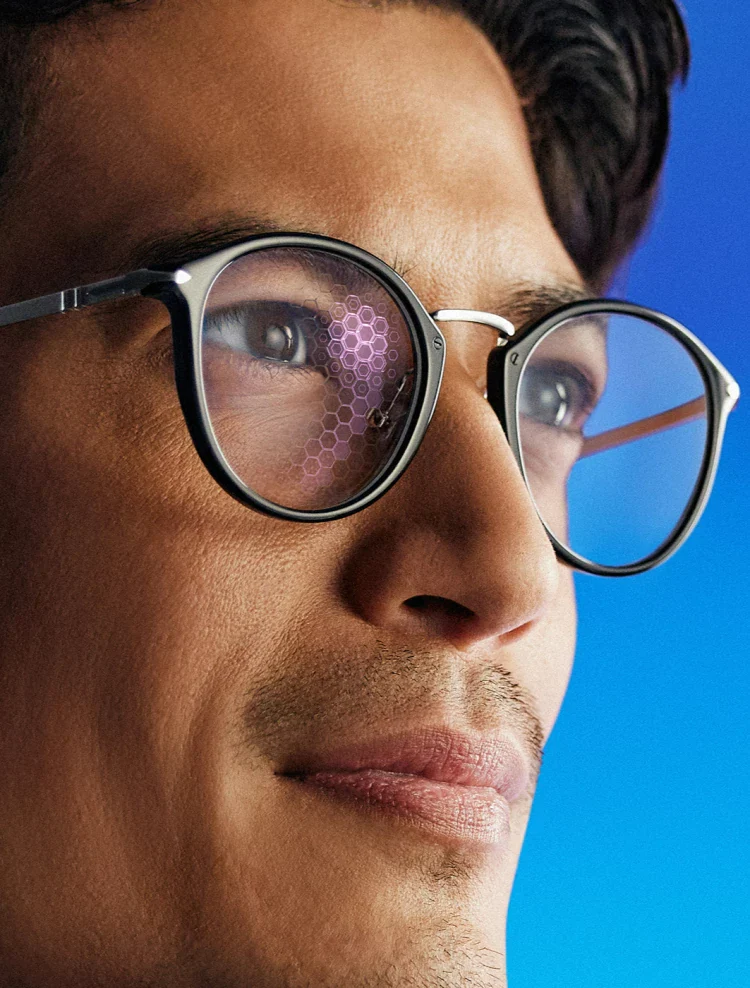
Essilor is the world's largest prescription lens manufacturer, a French company founded in 1972 and part of EssilorLuxottica since 2018. The name carries weight not from one flagship product but from four distinct lines, each solving a different problem: multi-distance vision, coating durability, screen-related eye strain, and changing light. Choosing the right line matters more than choosing the higher price point within it — and that choice starts with an accurate eye test.
What is Essilor known for?
Essilor International is a French multinational that designs, manufactures and sells prescription lenses along with optical equipment and machinery, and is the world's largest prescription lens maker. It was founded in 1972 from the merger of two French optical companies, Essel and Silor, headquartered in Charenton-le-Pont near Paris. Since October 2018, Essilor has been a subsidiary of EssilorLuxottica, formed when Essilor merged with the Italian eyewear group Luxottica.
That scale is why these four product names show up in optical shops across Asia and Europe — and why counterfeits exist too.
A genuine lens carries an etched marking on the lens surface, a warranty card, and sealed packaging. Ask to see all three before the lens is cut — once the edge is ground down, the packaging is the only evidence left.
Varilux: progressives and the field-of-view problem
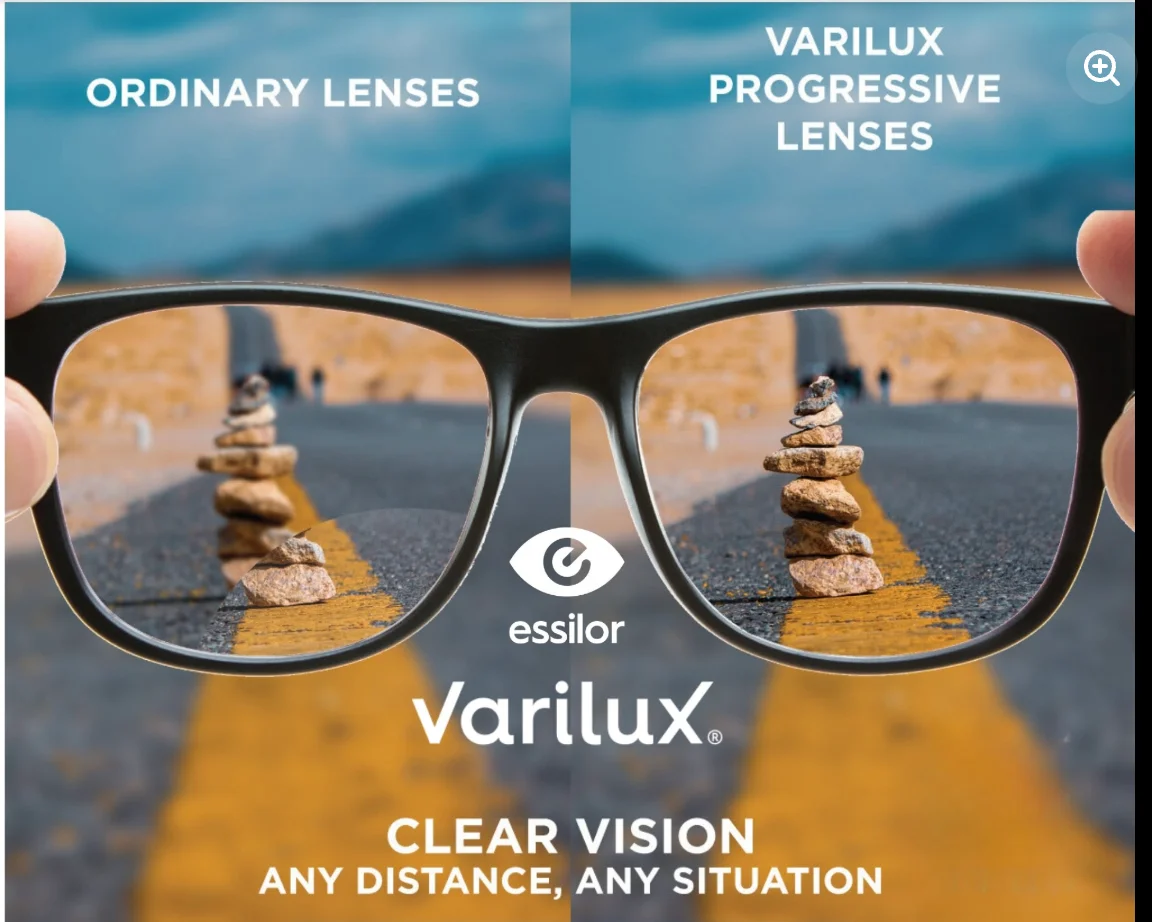
Varilux was the world's first progressive lens — invented by Essilor's Bernard Maitenaz in the 1950s and sold from 1959, replacing the visible line of a bifocal with a continuous gradient of power. One lens combines distance, intermediate and near vision; all three compete for space on the same lens surface, which is why the engineering question is how wide and stable the clear field of view can be before the edges start to distort.
The line is split by design, not just price. Varilux Comfort Max is built for easier adaptation; Physio 3.0 uses Synchroneyes technology to optimize both lenses as a pair when the two eyes differ in prescription; and the XR series is the current top tier: a design that responds to eye movement, accounting for viewing habits rather than just the prescription number, to stay sharp even while you're moving.
Newer generations widen the field of view and reduce the "swim" effect — the sensation of the room tilting when you turn your head — which is the most common reason people give up on their first pair of progressives. Adaptation typically takes days, not weeks, as long as the fitting height is measured on the actual frame you're wearing.
Crizal: the coating that decides how well a lens ages

Crizal isn't a lens, it's a coating system applied to a lens: anti-reflective, scratch-resistant, resists dust and water, with UV protection on both sides. This is what determines whether, after a year of being pocketed, wiped on a shirt hem, and caught in the rain, your glasses still look clean.
The naming tells you what each tier prioritizes: Crizal Easy Pro is the everyday tier; Sapphire HR cuts reflections from every angle around the lens; Rock leans toward scratch resistance; Prevencia filters part of the blue-violet light spectrum. Ask exactly which tier is quoted — "has Crizal" on an invoice alone doesn't say much.
If you're going to spend extra anywhere, spend it here — regardless of prescription strength. The anti-reflective layer also removes the white glare that ruins photos and tires the eyes on a night drive.
Eyezen: for eyes that live with screens
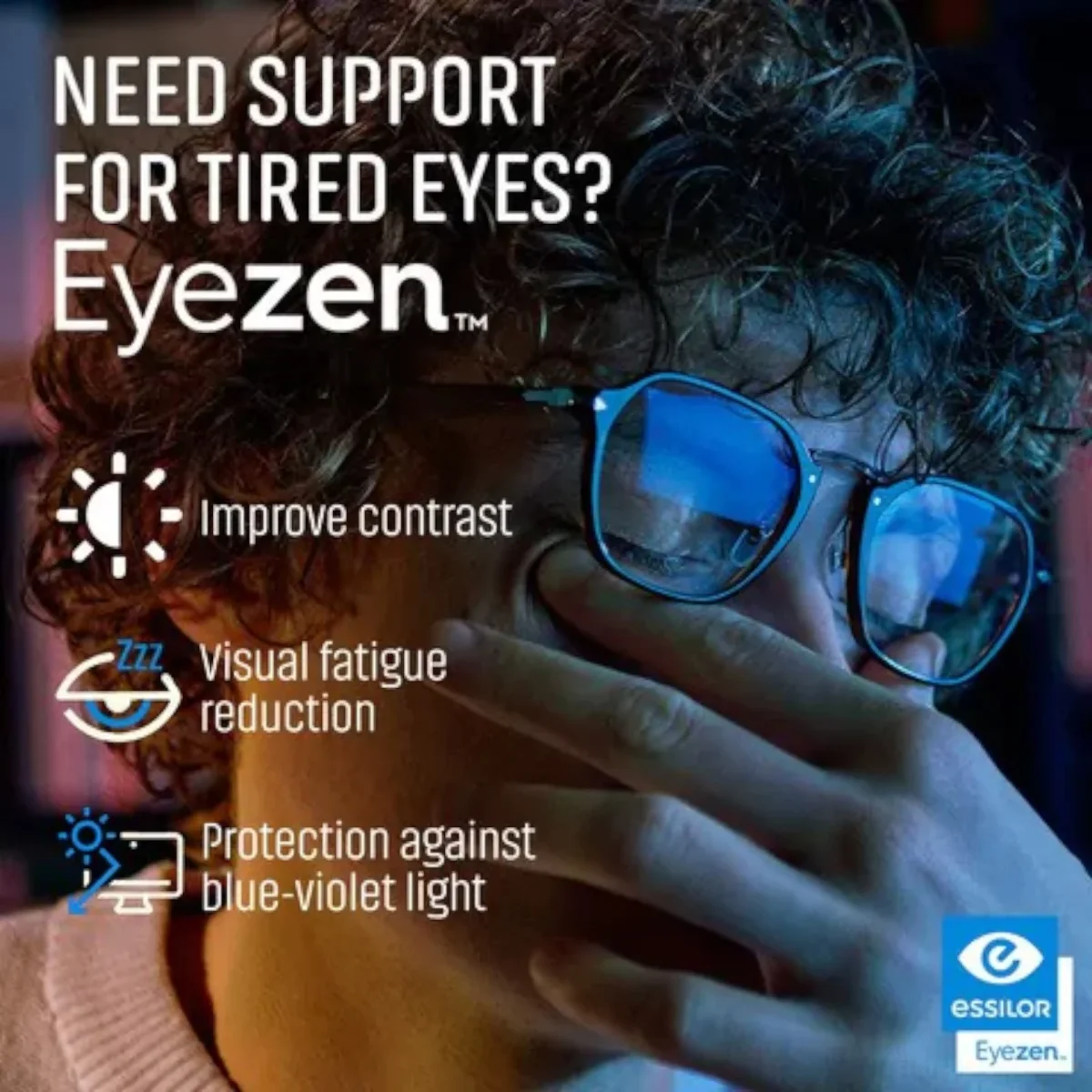
Eyezen is a single-vision line, not a progressive. It adds a small amount of near-vision support to the lower part of the lens, along with blue-violet light filtering, for people with a mild or no prescription whose eyes still feel heavy by evening. Eyezen Start gives light support; Eyezen Boost is stronger, with the level chosen according to age and how much close-up screen time you do.
There's also an Eyezen Kids version, designed around a child's smaller face and closer near-vision distance. What no version does is correct presbyopia — the support is deliberately kept light, enough that the eye muscles don't have to hold near focus for eight straight hours, and no more than that.
Transitions: lenses that adapt to light
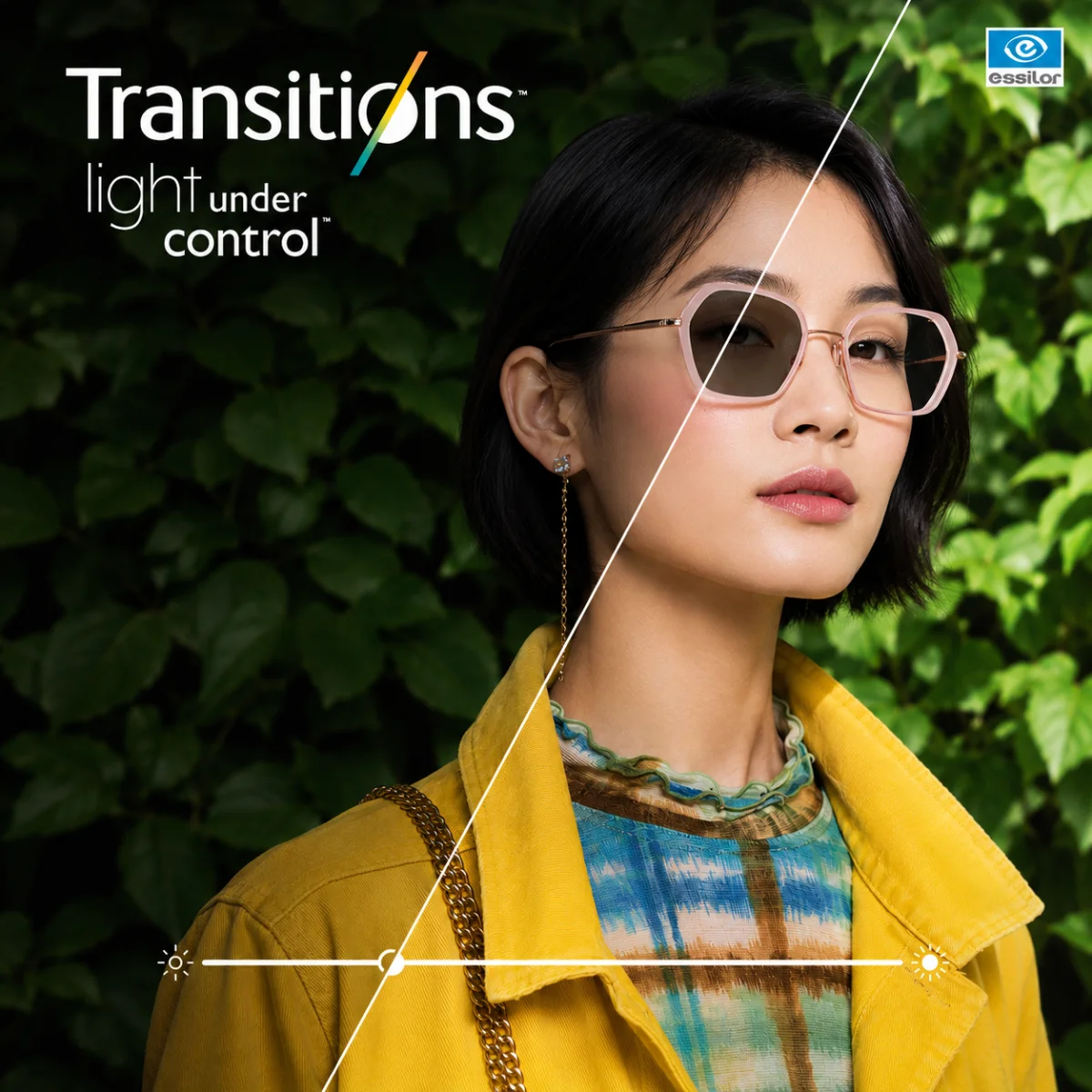
Transitions is a color-changing technology, not a lens design — made by Transitions Optical, wholly owned by Essilor since 2014, and available paired with Varilux or Eyezen designs. It handles light, not focus: clear indoors, dark outdoors, and blocking UV in both states. The current generation is Gen S, which replaced Signature Gen 8 in 2024, darkening in about half a minute and clearing noticeably faster once back indoors.
One honest limitation: behind a car windshield, a standard Transitions lens barely darkens at all, since windshield glass already filters out the UV that triggers the reaction. The XTRActive version is the exception — it darkens partially even behind car glass and goes darker in strong heat and sun — but for frequent drivers, a separate tinted or polarized pair of sunglasses is still the better option.
Getting tested and fitted for Essilor lenses at Manh Long Optical
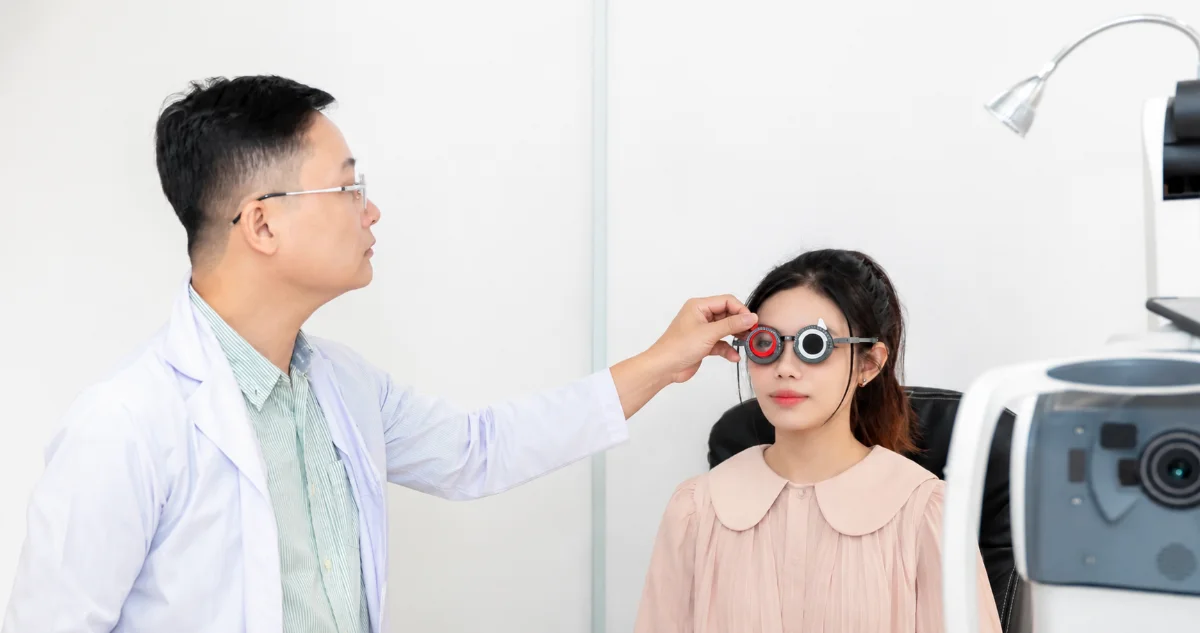
A high-tech lens only performs when the prescription and optical center are right, and the premium Varilux designs are the least forgiving of a mismeasurement. In the shop, we measure your refraction, pupillary distance, and fitting height on the exact frame you've chosen, check how the frame sits on your face, then select an index — 1.60, 1.67 or 1.74 for a strong prescription — matched to the frame's depth so the lens edge doesn't come out thick.
Every Essilor lens we cut comes with sealed packaging and a warranty card. In the first two weeks, you can come back for a free check and adjustment — the exact window when a progressive lens either settles in or needs a tweak.
Overview of Essilor's lens lines
Each Essilor line targets a specific problem, not a price tier.
| Line | Solves | Suited to |
|---|---|---|
| Crizal | Anti-reflective, scratch resistance, easy to clean | Anyone — worth having on every lens |
| Varilux | Progressives for presbyopia | Over 40, needs both distance and near vision |
| Transitions | Automatically darkens with light | Frequently outdoors, doesn't want two pairs |
| Eyezen | Reduces screen-related eye strain | Office workers, students |
Common questions
- Which Essilor line suits all-day computer work?
- Eyezen — designed to reduce the effort of focusing at arm's-length screen distance and filters some blue-violet light.
- Is Crizal a lens or a coating?
- A coating, applied over most Essilor lens designs — it's the anti-reflective, anti-scratch layer, not the lens shape itself.
- Can Varilux and Transitions be combined?
- Yes, the progressive design and the color-changing ability are independent choices that can be combined in the same lens.
- How do I know which Essilor line I need?
- Describe your daily habits — screen time, driving, age, how much time you spend outdoors — to a technician at Manh Long Optical, and they'll recommend the right line.
- Are Essilor lenses more expensive than other brands?
- Usually positioned at the premium end, reflecting lens design research and coating quality; you can ask for a comparison quote against ZEISS in-store.
- Which Essilor line should I start with?
- Almost always Crizal — the coating decides how well a lens ages. Varilux, Eyezen or Transitions are only worth it when the problem they solve is actually your problem.
- How long does it take to adapt to progressives?
- Usually a few days, and each day should feel easier than the last. If it doesn't, it's usually the fitting height or frame position that needs rechecking — come back for a remeasure.
- Do Transitions lenses darken inside a car?
- Barely. Windshield glass filters out the UV that triggers the reaction, so a separate pair of sunglasses is still the better option for driving.
Come compare in person
At Manh Long Optical, frames, prescription lenses and sunglasses are all measured, cut and fitted in the shop in one visit. Come in for a refraction test and lens consultation — we'll tell you honestly which line actually fits your routine.
Manh Long Optical — 147A Le Duan, Cua Nam, Hanoi
Open daily 8:00 – 21:30
0777 986 999 · WhatsApp · Zalo · mlong.optical@gmail.com · Directions