Home › Learn › Multifocal Lenses
LENSES
Multifocal Lenses: What They Are, How They Work, and Essilor Varilux
The first question we hear at the counter is usually:
"What is multifocal?"
Then:
"Is multifocal the same as progressive?"
Not exactly.
And if you are considering Essilor Varilux, there is another distinction worth understanding.
Varilux is the lens family. Multifocal describes what the lens does. Progressive describes one way a multifocal lens can be designed.
This page explains the difference and what to consider before choosing a multifocal lens.
What does "multifocal" mean?
A multifocal lens is a spectacle lens that provides more than one optical power or viewing range.
This is useful because your eyes need to focus at different distances throughout the day. For example:
- Distance — driving, walking, looking across the street
- Intermediate — computer screens, dashboards, conversations across a desk
- Near — reading, phones and other close work
A multifocal lens combines different viewing requirements into one pair of glasses.
The most common reason someone needs multifocal correction is presbyopia — the age-related change that makes close-up focusing more difficult. You may notice it when you start holding your phone farther away, need more light to read, or find yourself switching between distance and reading glasses.
Multifocal is a category, not one specific lens
This is where the terminology can become confusing. Multifocal is the broader category. Different lens designs can provide multiple viewing ranges in different ways. These include:
- Bifocal
- Multifocal
- Progressive
- Occupational or office multifocal lenses
They solve similar visual problems, but the optical design is different.
Different multifocal lens designs
Simplified view:
SINGLE-VISION → BIFOCAL → MULTIFOCAL → PROGRESSIVE
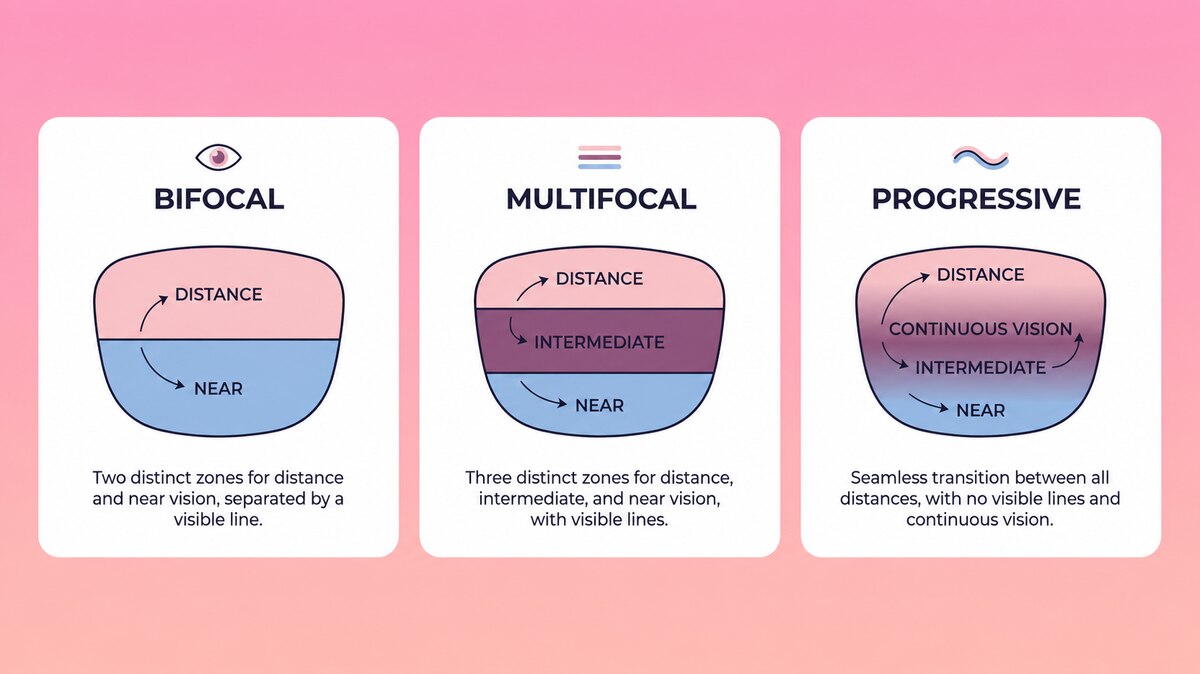
The diagram above is only a simplified illustration. The exact shape and size of each viewing area can vary depending on the lens design and prescription.
Single-vision
A single-vision lens has one main optical power. It is normally designed for one primary viewing distance: distance, intermediate, or near. It is not a multifocal lens.
Bifocal
A bifocal provides two main viewing ranges, usually distance + near. The near area is normally separated by a visible segment. The advantage is that the two viewing areas are clearly defined. The trade-off is the visible line and the lack of a dedicated intermediate area in a traditional bifocal.
Multifocal
A multifocal lens provides more than one viewing range within the same lens. Depending on the design, this can include distance + intermediate + near. The exact arrangement depends on the lens.
Progressive
A progressive lens is one type of multifocal lens. Instead of clearly separated segments, the optical power changes gradually across the lens. In simple terms: distance → intermediate → near. There is no visible segment line.
Multifocal vs Progressive: What's the difference?
The easiest way to remember it is: all progressive lenses are multifocal, but not all multifocal lenses are progressive.
| Criteria | Multifocal | Progressive |
|---|---|---|
| Meaning | Broad category of lenses with more than one viewing range | One type of multifocal lens |
| Distance | Yes | Yes |
| Intermediate | Depends on design | Included; usable area depends on design |
| Near | Yes | Yes |
| Visible line | Depends on design | No visible segment line |
| Power change | Depends on design | Gradual |
| Examples | Bifocal, multifocal, progressive | Progressive multifocal |
So when someone says "I need multifocal glasses," that is only the starting point. The next question is: "Which multifocal design?"
Why do people need multifocal lenses?
Usually, one prescription is no longer enough for every distance. This commonly happens with presbyopia. You may still see clearly across the room but struggle to read a menu. Or you may be able to read comfortably but need your distance glasses again when you look up.
A multifocal lens can bring these different viewing requirements into one pair. That is the main reason people choose multifocal glasses.
What is a progressive multifocal lens?
A progressive multifocal lens changes optical power gradually across the lens. There is no visible line between distance and near. In everyday use:
Looking across the road — you generally use the upper part of the lens.
Looking at a computer — you use a lower-middle area.
Reading your phone — you use the lower part of the lens.
But these are not three sharply separated boxes. The optical surface changes continuously, and the useful area depends on the lens design, prescription, frame and fitting. This is why two progressive lenses can feel quite different even though both are technically progressive.
The trade-off with progressive multifocal lenses
Progressive lenses provide the convenience of using one pair for several distances. But there are compromises. Some new wearers may notice:
- Peripheral blur
- Smaller usable areas for certain distances
- Slight visual distortion when first wearing the lens
- The need to move the head to find the clearest area
- An adaptation period
How much you notice these effects varies between people. Lens design, prescription, frame size and fitting measurements all affect the experience. A more sophisticated design can reduce some of these compromises, but accurate fitting is still important.
Essilor Varilux: a multifocal lens family
If you have decided that a multifocal lens is worth considering, the next question is often: "What about Varilux?"
Essilor Varilux is Essilor's multifocal lens family. The first Varilux lens was developed in 1959 by French engineer Bernard Maitenaz. Since then, Essilor has continued developing the Varilux range around the changing visual needs of multifocal wearers.
Many Varilux products use progressive lens designs, providing a gradual transition between distance, intermediate and near vision without a visible segment line. So it is useful to keep the terminology separate:
- Multifocal — what the lens does: provides more than one viewing range.
- Progressive — one type of multifocal design: the optical power changes gradually without visible segments.
- Varilux — Essilor's branded family of multifocal lens designs.
Why are there different Varilux multifocal lenses?
There is no single multifocal design that is identical for every wearer. Someone buying their first multifocal glasses may have different priorities from someone who has worn multifocals for many years. Someone working at a desk may also have different requirements from someone who drives, travels and spends a lot of time outdoors.
This is why the Varilux range contains different designs. The useful question is not simply "Which Varilux is the most expensive?" It is "Which Varilux design matches the way I use my eyes?"
Varilux Liberty 3.0 — Everyday multifocal vision
Varilux Liberty 3.0 is an accessible Varilux design intended for everyday visual needs. The design focuses on comfortable vision across different distances and relatively easy adaptation.
This can make it worth discussing for someone who is:
- New to multifocal glasses
- Looking for one pair for general everyday use
- Not particularly demanding in terms of dynamic vision
- Looking for a simpler entry into the Varilux range
The important point is that a simpler design is not automatically a bad design. If your visual requirements are straightforward, you may not need every advanced feature available in a premium multifocal lens.
The trade-off: wearers with more demanding visual behaviour may want to consider the additional design features available in higher Varilux ranges.
Varilux Comfort Max — A focus on comfort and adaptation
Varilux Comfort Max places more emphasis on comfortable vision and adaptation across everyday distances. The idea is simple: a multifocal lens should not only provide the required prescription. It should also make it easier to move between different viewing distances — road → phone → computer → conversation → reading. The lens needs to support these changes throughout the day.
Comfort Max may be worth discussing if you:
- Wear your glasses for most of the day
- Want a comfortable general-purpose multifocal
- Are concerned about adapting to multifocal glasses
- Need distance, intermediate and near vision
- Want something beyond a basic multifocal design
The trade-off: people with particularly demanding dynamic visual requirements may want to look at the more advanced Varilux designs.
Varilux Physio — Binocular vision and stability
Varilux Physio takes another approach by placing greater emphasis on how the two eyes work together — known as binocular vision. That becomes particularly relevant when you frequently change viewing distance or move around during the day: walking, driving, moving between indoor and outdoor environments, looking from near to far, changing focus while moving. Physio is designed to support a more stable visual experience across these situations.
It may be worth discussing if you:
- Move frequently throughout the day
- Change viewing distances often
- Want more emphasis on visual stability
- Already wear multifocal lenses
- Have more demanding everyday visual requirements
The trade-off: the additional design features may not be necessary for someone with simpler visual requirements.
Varilux XR Series — Dynamic vision and advanced lens design
At the premium end of the Varilux family is the Varilux XR Series. The focus here is more strongly on dynamic vision — how your eyes actually move when looking at the world. Essilor describes XR Series as using AI-supported design to predict how the eyes look at objects. Essilor also highlights sharp vision in motion, stabilised vision, high visual acuity in low light, a panoramic field of vision and long-lasting near comfort.
The interesting part is not simply the word AI. Think about walking through Hanoi: you look far ahead → across the street → at a sign → at your phone → back at traffic → at someone beside you. Your eyes are constantly changing direction and distance. A multifocal lens therefore has to manage more than simply distance at the top and near at the bottom. XR Series is designed around this more dynamic visual behaviour.
It may be worth discussing if you:
- Are active throughout the day
- Frequently change viewing distances
- Drive regularly
- Travel often
- Move between indoor and outdoor environments
- Want a premium multifocal design
- Already wear multifocal glasses and want a more advanced design
The trade-off: XR Series is a premium design, so its additional features may not be relevant to every wearer.
Varilux at a glance
Rather than asking "Which Varilux is best?" — start with "What do I need my glasses to do?"
| Varilux design | Main emphasis | May be worth discussing if you... |
|---|---|---|
| Liberty 3.0 | Everyday vision and adaptation | Are new to multifocals or have straightforward visual needs |
| Comfort Max | Comfort and everyday flexibility | Want a comfortable general-purpose multifocal |
| Physio | Binocular vision and stability | Move frequently or change viewing distances often |
| XR Series | Dynamic vision and advanced design | Have demanding visual requirements and want a premium option |
This is a guide, not a prescription. The actual choice depends on your prescription, visual habits, frame and fitting measurements.
Is the most expensive Varilux automatically the right choice?
Not necessarily. A more advanced lens design can provide additional optical features. But those features only matter if they address your visual needs.
For example, a first-time multifocal wearer with straightforward daily activities may have different priorities from someone who drives frequently, travels and constantly changes viewing distances. Both people may need multifocal glasses. They do not necessarily need the same Varilux design.
What should you compare between Varilux designs?
Look beyond the product name.
- Viewing areas — how much usable vision is available at different distances?
- Transition — how does the lens move from distance to intermediate to near?
- Peripheral vision — how much reduced clarity may the wearer notice outside the main viewing areas?
- Dynamic vision — how stable is vision when the wearer or environment is moving?
- Near vision — how comfortable is the lens for reading, phones and close work?
- Adaptation — how easy is it for a new wearer to learn the lens?
- Personalisation — how much can the lens design be adjusted around the wearer, prescription and frame?
These are the differences worth discussing when comparing multifocal lenses.
Varilux is only part of the equation
A premium multifocal lens still needs accurate fitting. For multifocal lenses, we consider:
- Prescription
- Near addition
- Pupillary distance
- Fitting height
- Frame position
- Frame size
- Daily visual activities
- Previous multifocal experience
The lens and the fitting should be considered together. A sophisticated lens with inaccurate measurements can still be uncomfortable.
Which multifocal lens should you choose?
There is no universal answer.
If this is your first multifocal, adaptation and everyday comfort may be your main concerns. If you use your glasses all day across many activities, a more sophisticated general-purpose design may be worth discussing. If you are active and frequently change viewing distances, dynamic vision and stability become more relevant. If you want a premium Varilux design, XR Series is the range to discuss.
But the starting point is always your eyes. Then your prescription. Then how you actually use your glasses. Only after that should you choose the multifocal design.
Multifocal lenses at Manh Long Optical
The easiest way to choose a multifocal lens is not to memorise every product name. Tell us what you do during the day: driving, computer work, reading, phone, travel, outdoor activities. We will check your prescription and fitting requirements, then explain which multifocal options make sense for you.
If you already wear multifocal glasses, bring them with you. They can help us understand what you have been wearing and what has or has not been working.
Test first, decide after.
For premium multifocal lenses from Essilor and ZEISS, production time depends on the prescription, lens design and laboratory requirements. If you are visiting Hanoi with a flight deadline, let us know before ordering so we can check the available production time.
The right multifocal lens is not simply the most expensive one. It is the one that matches your prescription, your frame and the way you use your eyes every day.
Multifocal Lenses FAQs
Is multifocal the same as progressive?
No. Multifocal is the broader category. Progressive is one type of multifocal lens.
Is Essilor Varilux a multifocal lens?
Yes. Varilux is Essilor's multifocal lens family. Many Varilux designs use progressive lens technology.
Is Varilux the same as progressive?
No. Progressive describes the lens design. Varilux is Essilor's branded lens family.
Are all multifocal lenses progressive?
No. Bifocal and other multifocal designs also provide more than one viewing range.
Why can multifocal lenses feel blurry at the sides?
Some multifocal designs have areas outside the main viewing corridors where vision is less clear. The amount varies with the lens design, prescription and fitting.
Do I need the most expensive Varilux?
Not automatically. The appropriate Varilux design depends on your prescription, daily activities, frame and fitting requirements.
Can I use multifocal glasses for computer work?
Yes, but the appropriate design depends on your working distance and how much time you spend at a computer. For people who spend long periods at a desk, an occupational or office multifocal lens may also be worth discussing.
Find the multifocal lens that fits how you actually live
Visit Manh Long Optical for a free eye test and a fitting check based on your prescription, frame and daily habits, not just a product name. Staff will tell you plainly which Varilux design fits, and which one doesn't.
Manh Long Optical · 147A Le Duan, Cua Nam, Hanoi
Open daily 8:00 – 21:30 · 0777 986 999 · WhatsApp · Zalo · Directions