Home › Learn › Anti-Reflective, Blue-Light, UV: What Each Coating Does
LENSES
Anti-Reflective, Blue-Light, UV: What Each Coating Does
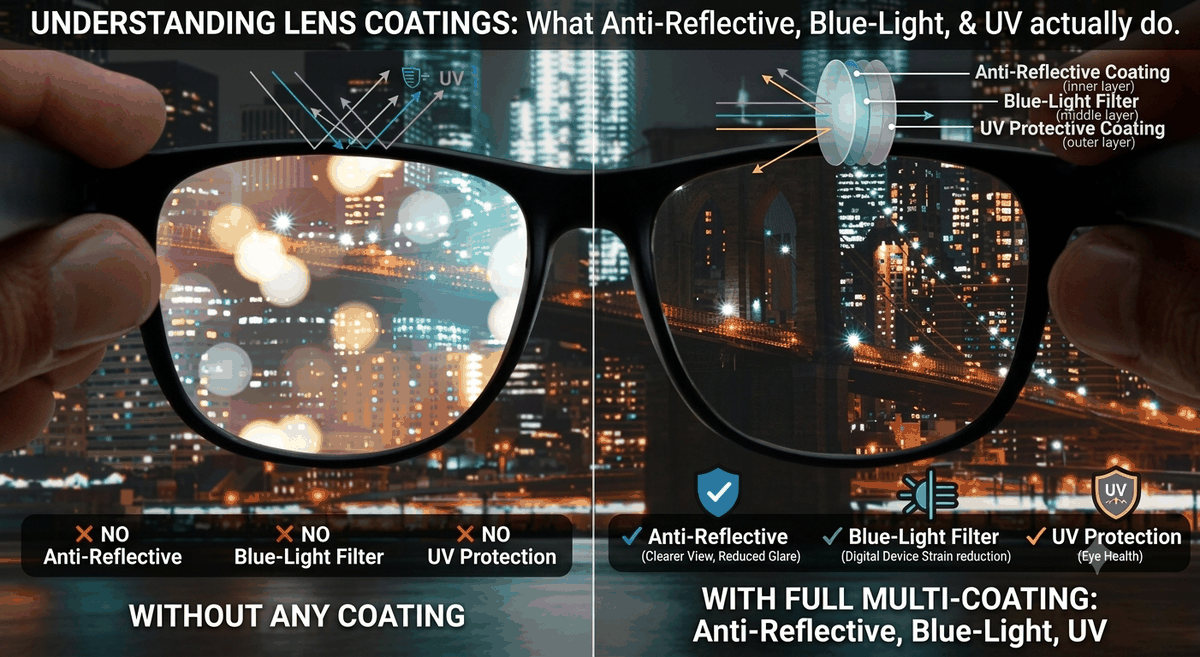
On a quote, coatings usually get bundled into one line, but they solve problems that have nothing to do with each other: glare, screen-related eye strain, and ultraviolet exposure. Knowing what each one actually does, and which claims have evidence behind them, makes choosing simple.
Anti-reflective: pick this one first
Anti-reflective coating cuts the glare bouncing off both sides of the lens. It's most obvious at night, under fluorescent lighting, and on video calls, where an uncoated lens shows your own reflected eyes staring back.
It also lets slightly more light through, so the same prescription looks a bit sharper. If you can only spend extra on one thing, spend it here.
Blue-light filtering: what the evidence says
Blue-light filtering cuts part of the high-energy blue wavelength coming from screens and LED lighting. A 2023 Cochrane review of seventeen randomized trials found no meaningful difference in short-term eye strain compared to uncoated lenses, and no evidence it protects the retina either.
We still fit it when customers ask, since some people report feeling less strained after long sessions. But file it under comfort, not health, and it doesn't replace actually stepping away from the screen.
UV protection: not automatic
Clear plastic lenses don't filter ultraviolet on their own. This has to be requested, and it matters just as much for clear everyday lenses as it does for sunglasses.
Anything sold as sunglasses should block UV fully, regardless of how dark the tint is. A dark tint without UV protection is worse than wearing nothing, because your pupil dilates behind that tint.
A sensible combination
For most people: anti-reflective plus UV protection, with scratch resistance usually already bundled into that same coating package. Add blue-light filtering only if you're on a screen all day and want to try it.
Ask what the coating warranty covers and how to clean it properly. A premium coating wiped with a shirt hem holds up no better than a cheap one.
Coating summary
What each coating does, and whether it should be on every pair.
| Coating | Solves | Should it be standard |
|---|---|---|
| Anti-reflective (AR) | Reduces glare, improves clarity and looks | Should be on every lens |
| Blue-light filtering | Reduces screen-related eye strain | Optional, depends on screen habits |
| UV protection | Blocks ultraviolet from the sun | Should be on every lens |
| Scratch / smudge resistance | Extends lens lifespan | Recommended for daily wear |
Common questions
- Does a pair of glasses need all three coatings?
- Not necessarily — anti-reflective and UV protection should be on nearly every pair, while blue-light filtering is optional depending on your screen habits.
- If I can only pick one coating, which should I prioritize?
- Anti-reflective, since it affects daily comfort, night driving, and how clear your lenses look in every photo.
- Do scratch resistance and anti-reflective coating always come together?
- Usually — most premium coating packages like Crizal already bundle scratch resistance, smudge resistance and anti-reflective into one coating.
- How do I clean coated lenses without damaging them?
- Rinse with water first to remove grit, then wipe with a microfiber cloth. Avoid a dry cloth or tissue, which can scratch the coating.
- Can an old lens be recoated?
- No, coatings are applied during manufacturing, so a new coating means a new lens, not a coating added onto an old one.
- Are blue-light glasses just a sales gimmick?
- Not a gimmick, but oversold. The filtering itself is real; the health claims aren't currently supported by evidence. Treat it as an optional comfort feature, and prioritize anti-reflective first.
- Why do my anti-reflective lenses always look smudged?
- Because the coating makes fingerprints and oil more visible, not because it actually attracts more of them. Rinse with warm water and a little mild soap, then wipe with a clean microfiber cloth.
- Can a coating be added to lenses I'm already wearing?
- No. Coatings are applied during manufacturing, so adding one means cutting a new lens. If your current lens is already scratched, that's usually the moment to decide.
Come compare in person
Reading about it only gets you so far. Trying it on tells you more. Come to 147A Le Duan for a refraction test and frame trial, testing, cutting and fine-tuning done in one visit. Whatever you need, we'll tell you; if you don't need it, we'll tell you that too.
Manh Long Optical — 147A Le Duan, Cua Nam, Hanoi
Open daily 8:00 – 21:30
0777 986 999 · WhatsApp · Zalo · mlong.optical@gmail.com · Directions