Home › Learn › Is Anti-Reflective Coating Worth It
COATINGS
Is Anti-Reflective Coating Worth It? When It Really Matters
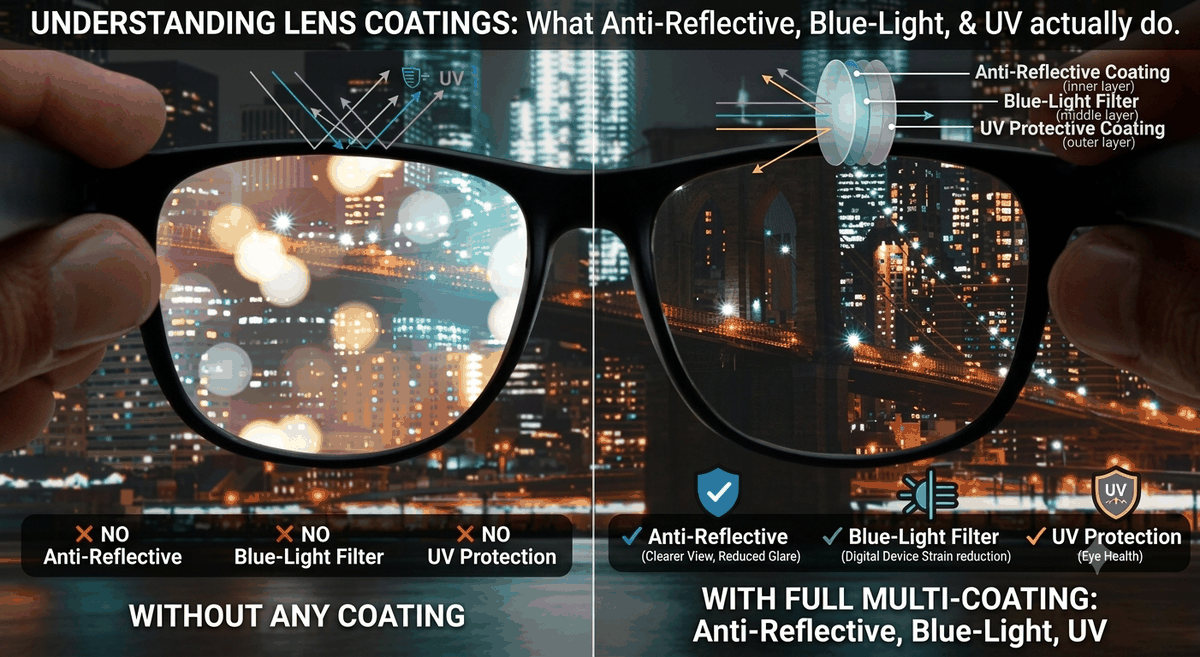
Anti-reflective coating often comes up as an upsell when buying glasses. But the real question isn't "should I pay for it" — since most lens packages here already include it — it's whether it actually matters for how you wear your glasses. This page goes straight to the specific situations, so you can tell which group you're in.
What anti-reflective coating actually solves
Light bounces off both surfaces of a lens, not just the front — creating bright streaks or reflections that block part of your view, and that show the person facing you a reflection of the room instead of your eyes. AR coating cuts most of that reflected light, while letting more usable light pass through the lens — so at the same prescription, vision tends to look slightly sharper.
It's one of three common coatings — alongside blue-light filtering and UV protection, each solving a different problem. Our lens coatings guide covers all three; this page goes deeper on AR specifically and the real situations where it matters.
Night driving: where it matters most
Oncoming headlights, streetlights, and reflections off wet road surfaces can all create glare on an uncoated lens, layered right over what you're actually trying to see. For anyone who drives or rides regularly after dark, this is the single situation where AR coating makes the clearest difference, because it combines everything at once: low light, multiple strong sources, and the need for a fast reaction.
Heavy screen use: less glare, not less strain
Room lighting and screen light reflect straight back off your lenses at close range for hours at a time, so glare builds up more than it would outdoors. AR coating reduces that glare, making long work sessions more comfortable.
One distinction worth being precise about: eye strain from screen use mostly comes from blinking less while focused up close, not from reflections. AR coating reduces visual discomfort — glare, streaks of light — not eye strain itself. Regular breaks are still the actual fix for eye strain.
Video calls, photos, meeting clients
Cameras and room lighting usually sit right at eye level, aimed straight at your lenses — exactly the angle where reflections show up most. Uncoated lenses often show a visible glare or a shadow over the eyes on a video call or in a close-up photo. For anyone who's regularly on camera, in client meetings, or photographed often, this is the third situation where AR coating makes a noticeable difference, even to people who don't normally think about lens specs.
When it's reasonable to skip it
A few cases where the upgrade isn't worth extra thought: reading glasses used a few minutes at a time, a spare pair that's rarely worn, or a genuinely tight budget where the money is better spent elsewhere (frame, correct index). Outside those narrow cases, for a pair worn daily, the price difference is usually small next to the benefit you'll notice every day.
On pricing: usually bundled, not a separate line item
At Manh Long Optical, anti-reflective and UV protection are typically bundled into the same lens package rather than sold as two separate charges. Pricing by index and brand is in our lens index guide. The real decision usually isn't "should I add AR" but whether to step up to a premium branded coating — see the real comparison in Crizal Easy Pro and Crizal Natural Look.
Does it make lenses scratch more easily
Not on its own. Premium coating packages like Crizal usually bundle anti-reflective, scratch-resistant and smudge-resistant layers into one coating, so a good AR lens is typically as durable as an uncoated one, or more. How you clean and store your glasses affects durability more than the coating itself — see how to clean and care for your glasses.
Common questions
Is anti-reflective coating a mandatory add-on?
Not a separate paid add-on in most cases — at Manh Long Optical, AR coating is usually already bundled into the lens package along with UV protection. The real decision is whether to upgrade to a premium branded coating like Crizal, not whether to add AR at all.
Does anti-reflective coating help with computer eye strain?
It reduces glare bouncing off your screen, which is more comfortable during long sessions. But eye strain from screen use mostly comes from blinking less while focused up close, not from reflections — so this eases visual discomfort, not eye strain itself.
Do glasses I wear occasionally need anti-reflective coating?
You can reasonably skip it for reading glasses used a few minutes at a time, a rarely-worn spare pair, or when budget is genuinely tight. For daily-wear glasses, the benefit is usually worth far more than the price difference.
Can anti-reflective coating be added to lenses I already own?
No. The coating is applied during lens manufacturing, so getting it means a new lens, not adding it onto your current one.
Does anti-reflective coating make lenses scratch more easily?
Not on its own. Premium coating packages like Crizal usually bundle anti-reflective, scratch-resistant and smudge-resistant layers into one coating, so a good AR lens is typically as durable as an uncoated one, or more.
Why is uncoated glass so noticeable on video calls?
Screen light and room lighting hit the lens straight-on at close range, right at camera height — the exact angle where reflections show up most. Uncoated lenses often show a visible glare or eye-shadow on video that coated lenses don't.
Not sure if your current lenses have anti-reflective coating?
Bring your glasses to Manh Long Optical and our staff will check for free and advise whether upgrading makes sense, based on how you actually wear your glasses day to day.
Manh Long Optical — 147A Le Duan, Cua Nam, Hanoi
Open daily 8:00 – 21:30
0777 986 999 · WhatsApp · Zalo · mlong.optical@gmail.com · Directions