Home › Learn › Zeiss UVProtect: Blocking UV Up to 400 nm on a Clear Lens
LENSES
Zeiss UVProtect: Blocking UV Up to 400 nm on a Clear Lens

You put sunscreen on your hands and forget about your eyes. Almost everyone does.
UV goes in painlessly. No warning sensation, no redness that night, nothing telling you your cornea just took a dose — the bill shows up twenty years later, as a cataract. Zeiss UVProtect addresses exactly one gap in that story, and the gap is narrower than the marketing suggests: twenty nanometers.
What UV does to the eye
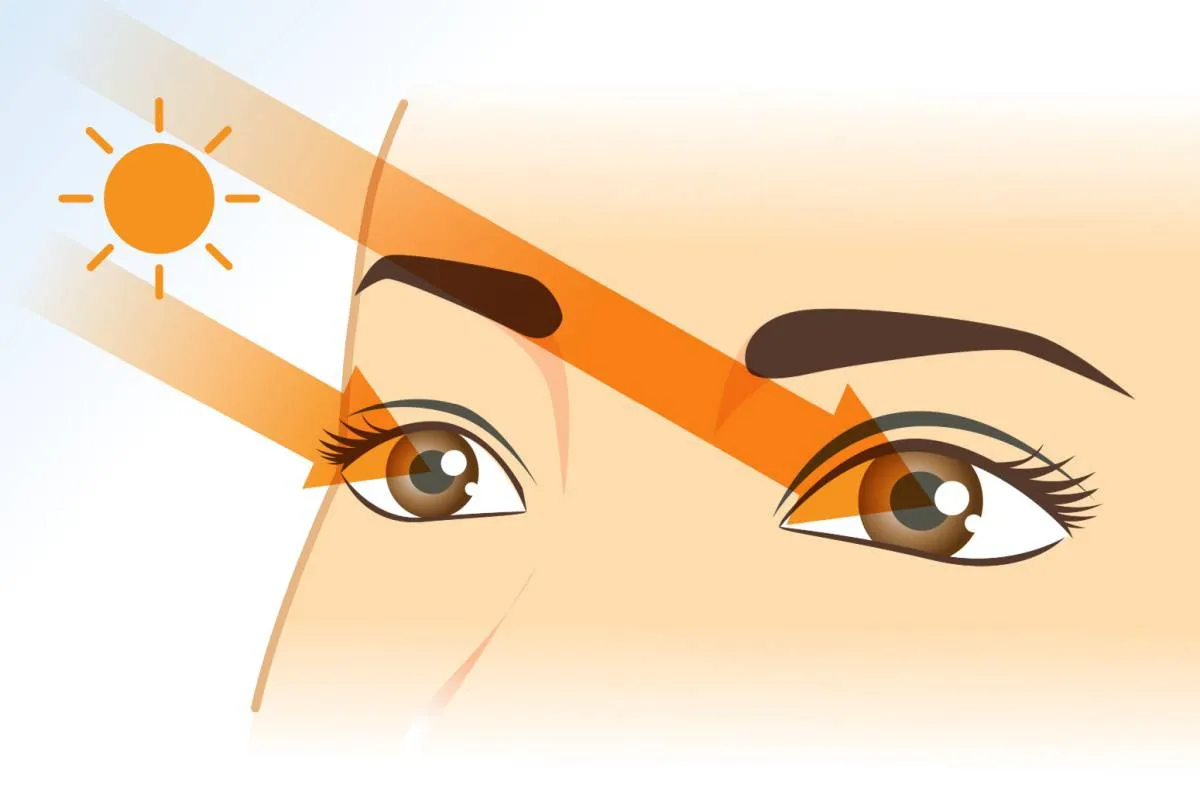
On the surface, UV causes photokeratitis (sunburn of the cornea) along with dry eye, and over years, pterygium — that wedge of tissue that gradually grows across the white of the eye, common in people who work outdoors, on boats, or on construction sites.
Deeper down, it accelerates oxidation in the lens and retina, which is why UV sits on the list of risk factors for cataracts and macular degeneration. One counterintuitive detail: most UV entering the eye arrives in the early morning and late afternoon, not at midday. A low sun sits level with the face and slips in under the brow line, where nothing is shading it.
Six in the evening on Le Duan, riding west with the sun straight in your face. That's the dose nobody accounts for.
The 20 nm gap
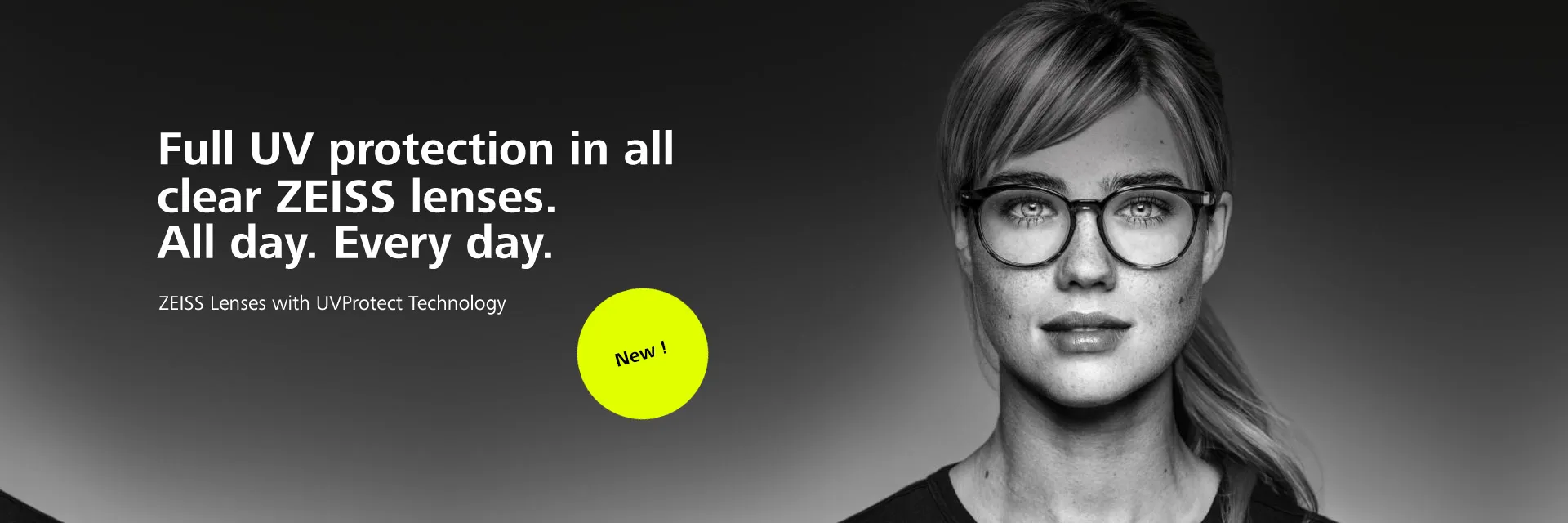
Here's the whole argument, stated precisely. International standards define the UV band as ending at 400 nm. A standard clear prescription lens blocks up to 380 nm. So the 380-400 nm range still gets through, and according to Zeiss, that slice carries roughly 30% of total UV radiation — the highest-energy part of it.
UVProtect closes that gap: blocking 100% up to 400 nm, on a lens that's still fully clear. Zeiss makes it standard across its entire clear-lens range rather than selling it separately, which is unusual enough to be worth saying plainly: this is a rare case where the better spec isn't an upsell.
Built into the material, not the surface
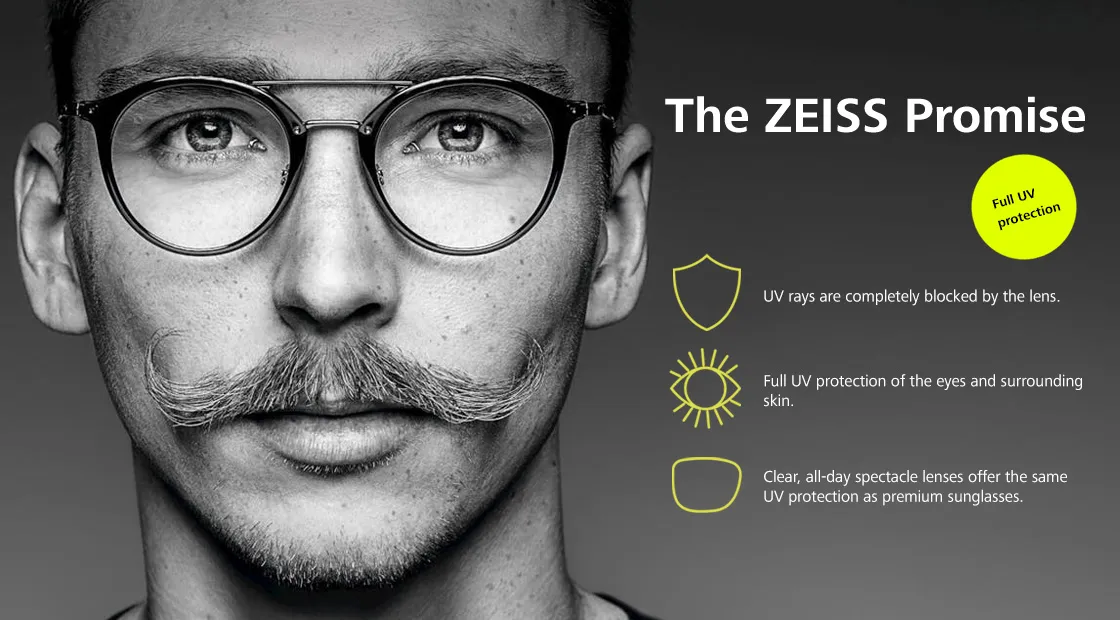
A surface anti-UV coating can wear off, get scratched through, or peel. Zeiss instead builds the UV-absorbing molecules directly into the lens blank material itself, so the UV protection is part of the lens body — not something you can wipe away and not something that wears down.
The engineering challenge is doing that without tinting the lens. The absorbing compound has to be selective: eating everything below 400 nm while letting everything above it through untouched. Get this wrong and you get the faint yellow tinge that gives away a cheap UV coating.
The back surface matters as much as the front
Sunlight doesn't only arrive from where you're looking. Light from behind and from the sides hits the back of the lens and bounces back into the eye, and Zeiss puts the figure at around 50% of harmful UV arriving that way. A lens that only blocks from the front leaves half the problem open.
The pairing here is UVProtect material combined with DuraVision anti-reflective coating on the back surface, engineered so UV doesn't bounce back toward the eye. The two layers do two different jobs. Order a Zeiss clear lens without the coating and you only have half the material's benefit. Ask to be sure, don't assume.
Who should treat this as non-negotiable
Everyone benefits. Four groups benefit more:
- People who work outdoors. Drivers, delivery riders, construction engineers, anyone on a motorbike for two hours a day.
- Children and teenagers. A child's lens is clearer than an adult's, so more UV reaches the retina. And they're outside far more than adults are.
- Anyone over sixty, when cataracts and macular degeneration are already a real prospect and every avoided dose helps.
- Anyone recovering from eye surgery — LASIK or lens replacement. Ask your surgeon what to shield and for how long. That advice outweighs everything on this page.
Fitting Zeiss lenses at Manh Long Optical
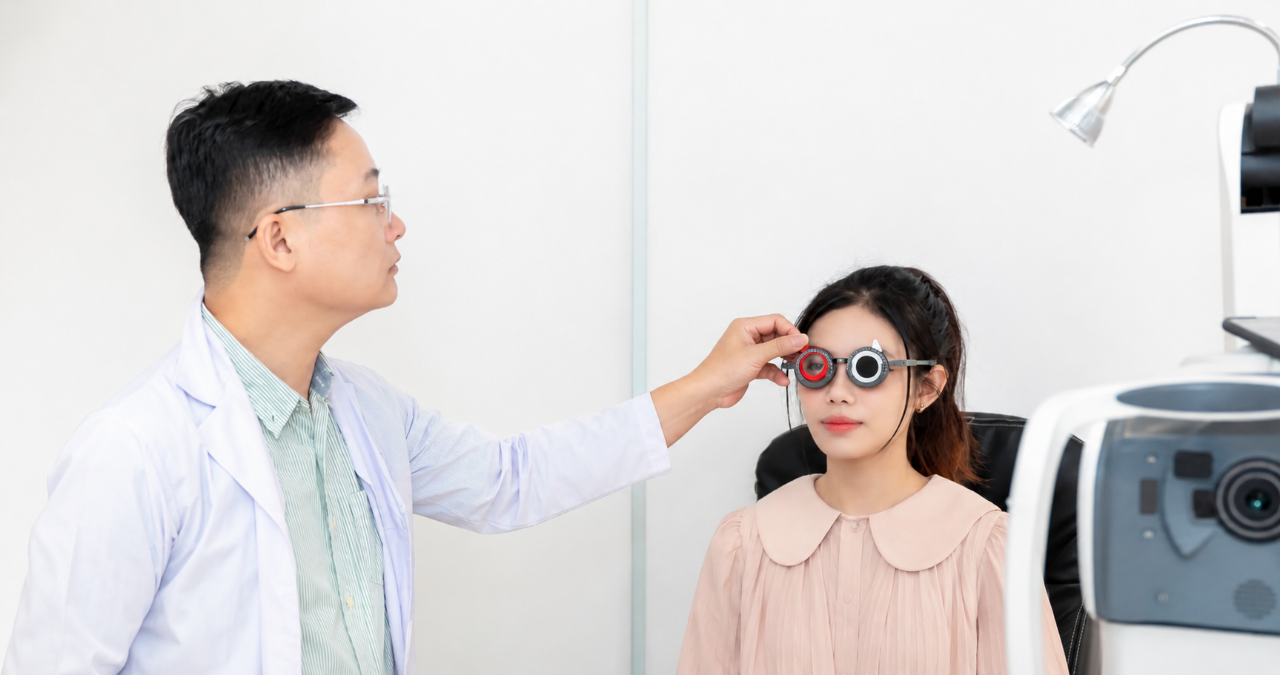
UV blocking is a property of the lens. Comfortable wear is a matter of fitting. Here that starts with an autorefractor, then a check with a trial lens kit — we don't just read the machine's number and cut. Pupillary distance is measured on the exact frame you've chosen, since being off by a few millimeters is enough to make all-day wear feel subtly wrong.
Measurement, cutting and fine-tuning happen in one visit at 147A Le Duan, Cua Nam. Bring the frame you like, or bring your current glasses if you'd like us to take a look at what you're wearing now.
Keeping the lens in good condition
Rinse with water first, then use a dedicated cleaning solution with a microfiber cloth. Wiping dry is what kills a coating: dust on the lens surface acts like sandpaper, and one pass leaves a mark. A shirt hem and tissue paper are the two things that scratch the most lenses, and almost everyone reaches for them.
When you take the glasses off, put them in a hard case. And never leave them on a car dashboard or in a motorbike seat box under the sun — heat does the rest, and no warranty covers that. One thing worth knowing: the UV-blocking ability lives in the material, so it stays intact even after the coating has been scratched up. The optics will bother you long before the protection fails.
Common questions
- Is there an extra charge for UVProtect?
- No. Zeiss builds it into every clear lens in the range, so any Zeiss clear lens you order already has it. The lens price still depends on the design and index you choose.
- Does a clear lens protect as well as real sunglasses?
- Against UV, yes — both types block up to 400 nm. Against glare, no. A clear lens does nothing about bright light itself, so you'll still squint in strong sun. Blocking UV and tinting the lens are two separate things.
- Does UVProtect make the lens look yellow?
- No. The absorbing compound works in an invisible wavelength band and lets visible light through unaffected, so color rendering stays accurate. This is exactly where cheap UV coatings tend to fail — they give off a faint yellow tinge.
- Do I need to worry about UV on an overcast day?
- Yes. Clouds cut visible brightness far more than they cut UV, so a gray afternoon can feel safe when it isn't. Your eyes don't signal anything either — there's no stinging sensation the way sunburned skin feels.
- Which Zeiss lenses have UVProtect?
- All clear lenses — single-vision, progressive, the SmartLife range. Ask at 147A Le Duan and we'll hand you the lens box so you can read the spec yourself.
- Is UVProtect the same as blue-light filtering?
- No. UV is invisible radiation below 400 nm. Blue light is visible light, roughly 400 to 500 nm, mostly from screens. They're different wavelength bands and two different things — a single lens can have both.
- So do I still need sunglasses?
- For comfort in bright light, yes. A clear lens does nothing about glare. Walk outside at midday and you'll still squint, and squinting all day is its own kind of tiring.
- How can I check a lens really blocks up to 400 nm?
- You can't tell by looking, and there's no in-store test that proves it. What you can do is buy from an authorized dealer, watch the sealed box get opened in front of you, and keep the paperwork. Ask us at 147A Le Duan and we'll show you the box.
- Does UV protection wear off over time?
- Not with UVProtect, since the absorbing compound is in the material itself rather than a surface coating. A surface anti-UV coating can wear down; this one doesn't.
Sources
- ZEISS UVProtect. Zeiss's official technology page for the material discussed here, including the blocking level the manufacturer states.
- The Sun, UV Light and Your Eyes. American Academy of Ophthalmology, on why UV protection matters for the eyes.
Come compare in person
Reading about it only gets you so far. Trying it on tells you more. Come to 147A Le Duan for a refraction test and frame trial, testing, cutting and fine-tuning done in one visit. Whatever you need, we'll tell you; if you don't need it, we'll tell you that too.
Manh Long Optical — 147A Le Duan, Cua Nam, Hanoi
Open daily 8:00 – 21:30
0777 986 999 · WhatsApp · Zalo · mlong.optical@gmail.com · Directions