Home › Learn › Contact Lenses or Glasses: Which Should You Choose?
GUIDE
Contact Lenses or Glasses: Which Should You Choose?
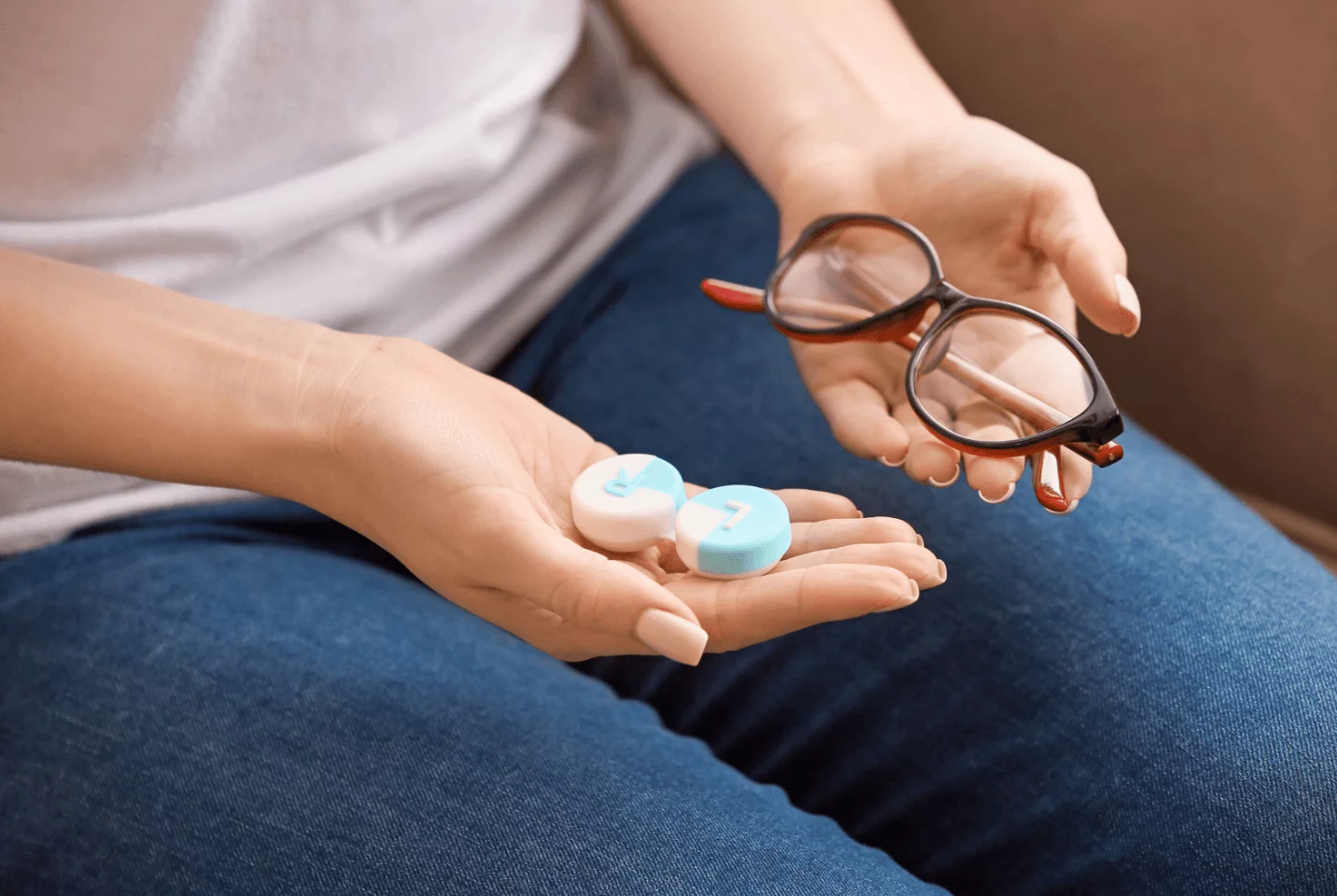
Both correct the same prescription, so the real choice comes down to comfort, daily routine and eye health. For most people, the honest answer isn't picking one, it's knowing which day calls for which.
What glasses give you
Glasses don't touch the eye: no putting in or taking out, close to zero infection risk, and the frame doubles as part of how you look. During a bout of dry eye or allergy season, this is simply the easier option.
The trade-off: your field of view is bounded by the frame, glare shows up more in sun or on camera, and stepping from an air-conditioned room into Hanoi's humidity fogs the lenses.
What contact lenses give you
Contacts move with your eye, so peripheral vision stays clear and sport isn't obstructed by a frame. At higher prescriptions, they also keep image size closer to natural than a thick lens does.
What you pay for that is discipline, and this isn't optional: contacts are a medical device, and wearing or storing them incorrectly raises the risk of microbial keratitis, an infection that can affect vision.
The hygiene rules that actually matter
Wash and dry your hands first, use fresh solution every time, never water, never top off old solution with new, and replace the case on schedule. Rub and rinse the lens, don't just soak it.
Two habits carry the highest measured risk: sleeping in lenses, and showering or swimming while wearing them. Research shows showering in contacts raises infection risk roughly threefold, and up to sevenfold with daily habitual showering in lenses.
Using both, with a separate fitting for each
Glasses for work and evenings, contacts for the gym or going out — this split makes sense: the eye gets a rest, and no single option has to cover every situation.
A contact lens prescription isn't the same as a glasses prescription, so it needs its own fitting, and contact wearers should have an annual eye exam. Redness, pain or blurred vision means take them out and get checked the same day.
Contacts vs glasses, side by side
The differences that affect daily life the most.
| Contact lenses | Glasses | |
|---|---|---|
| Peripheral vision | Unobstructed | Partly bounded by the frame |
| Long-term cost | Recurring, monthly | One-time, until your prescription changes |
| Hygiene & risk | Needs proper hand and lens hygiene, carries infection risk | No eye infection risk |
| Suited to | Sport, events, not wanting a frame | Daily wear, minimal handling |
Common questions
- Can I alternate days between contacts and glasses?
- Yes, this is fairly common and gives the cornea a day off, and many eye doctors encourage it.
- Are contacts more expensive long-term than glasses?
- Usually, since contacts are a recurring supply while a frame and lens are a one-time cost until your prescription changes.
- Is a contact lens prescription different from a glasses prescription?
- Yes, contact lens power differs slightly from a glasses prescription because the lens sits directly on the eye — contacts always need their own separate fitting.
- Can I wear contacts with astigmatism?
- Yes, using toric contact lenses, but they need a more careful fitting and may take an extra visit to get right.
- Should children wear glasses or contacts?
- Glasses are usually recommended first for children, since maintaining proper contact lens hygiene is hard to sustain at a young age.
- Can I wear contacts for a short nap?
- No, unless that specific lens type is approved by a doctor for it. Sleeping in lenses is one of the most clearly documented risk factors for corneal infection — even a short nap still means closed eyes for an extended period.
- Do contact lenses make your prescription get worse faster?
- No. Prescription changes come from how the eye develops and ages, not which correction you wear. Contacts used incorrectly cause dry eye and infection, not a worse prescription.
- Which is cheaper over a year?
- Glasses, almost always. A frame with a good lens lasts two to three years; daily or monthly contacts are a recurring cost, plus solution and cases.
Come compare in person
Reading about it only gets you so far. Trying it on tells you more. Come to 147A Le Duan for a refraction test and frame trial, testing, cutting and fine-tuning done in one visit. Whatever you need, we'll tell you; if you don't need it, we'll tell you that too.
Manh Long Optical — 147A Le Duan, Cua Nam, Hanoi
Open daily 8:00 – 21:30
0777 986 999 · WhatsApp · Zalo · mlong.optical@gmail.com · Directions